
Inside This section
Acromioclavicular Joint Separation
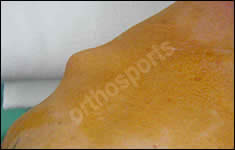
This is one of the most common shoulder injuries seen (usually from a sporting accident). It is particularly common in cycling, snowboarding, skiing, or football. The injury results from a fall onto the point of the shoulder and can be mild, moderate or severe.In a mild or moderate separation, the ligaments involved are stretched. In a severe injury, the ligaments that hold down the collar bone or clavicle are ruptured and the end of the collar bone appears very prominent.
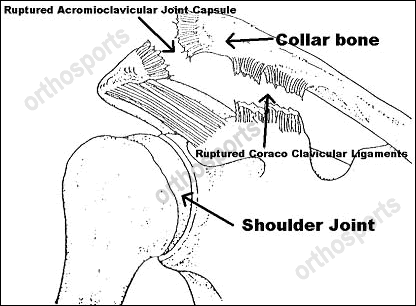
In the severe injury (called a Grade 3 injury) both the Coraco Clavicular ligaments and the Acromioclavicular capsule are torn (This leads to the deformity or bump on top of the shoulder).
Unfortunately these ligaments never completely heal. The severity of the injury is determined from the clinical examination and xrays (which may need to be done with you holding a weight).
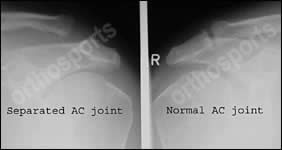
A mild or moderate separation (Grade 1 or Grade 2) can be successfully treated in a sling for a few weeks followed by a course of physiotherapy and gradual mobilisation. Most people do well without surgery.
The severe injury (Grade 3) can be treated either nonoperatively or operatively.
Non-operative treatment involves immobilisation in a sling for two to three weeks followed by a course of physiotherapy. The bump on top of the shoulder always remains prominent and occasionally arthritis of the acromioclavicular joint develops some years after the injury. The latter can be addressed at a later time with a small operation. The injury can be associated with ongoing pain in a small number of cases and also may lead to some permanent weakness in those persons who do heavy overhead work or do a lot of throwing.
Surgery involves a small incision over the top of the shoulder. The end of the collar bone is cut out because it is always damaged and the torn Coraco Clavicular ligament is replaced by an artificial ligament (made out of a strong synthetic material called Dacron or by using a tendon from another part of the body).
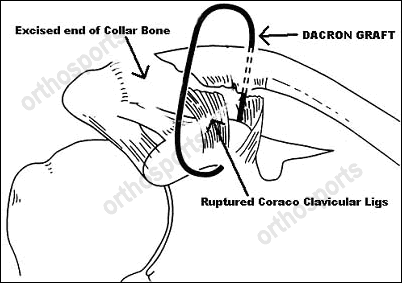
This surgery is much more successful when done within 3 weeks of the injury. Although it can be done later, the results of this particular operation may not be as good as if it was done soon after the injury. In long standing and chronic injuries a different operation is usually needed (This is called a Coraco Clavicular Fusion and a bone grafting procedure is required).
Generally speaking anyone who does heavy manual or overhead work should consider having the surgery done soon after the injury. This also applies to throwing or contact athletes.
With most other patients a non operative approach is appropriate on the understanding that you are accepting a small element of risk. That is, if you do not do well with nonoperative treatment, surgery may be needed at a later date. Unfortunately the delayed operation tends not to be as successful as an operation done immediately following the injury.
The Surgical Procedure
The operation takes about 90 minutes and involves the procedure outlined in the diagram above.
You will wake up in the ward in a sling and you will have a drain coming out of your shoulder. You will be given adequate pain killers to keep you comfortable.
The morning after surgery your drain will be removed. A waterproof dressing will be placed on the shoulder and you will be allowed to shower. When showering take the sling off but leave your arm adjacent to your body – do not attempt to lift or rotate the arm – and then put the sling back on after you are dry. Make sure the armpit is as dry as possible because of the risk of a sweat rash or an armpit infection. It is important to sit out of bed and walk around as soon as you are comfortable and able.
You can leave hospital that day if you feel well enough. The sling will need to remain on for at least 3 weeks. The sling must remain on 24 hours a day including at night. The sling only comes off to have a shower and get dressed and on those occasions the arm needs to be kept adjacent to the body.
After 3 weeks the sling is removed and you start gentle movements. You do not do any specific exercises or physiotherapy at this stage because it may compromise the graft.
After about six weeks (if your movements are fine) the sling will be removed and you can move the arm freely. You may be sent for physiotherapy or swimming at this time (but it does depend on your progress). Do NOT get alarmed when you notice that the end of the collarbone rides up by 1 cm. This is a normal occurrence and without this you will not regain full movement.
Full activity, including all sports, can usually be started by 3 months.
Rarely, at about 6 to 9 months the Dacron graft irritates the bone and causes a condition known as “osteolysis”. If this occurs the graft requires removal at about 12 months. By this time the other tissues have compensated for the damaged ligaments the collar bone usually remains stable in its position despite the graft being removed.