
Inside This section
Total Elbow Replacement
Overview
The elbow joint is one of many joints where different bones connect and allow motion. The elbow acts as a link between the shoulder and the hand and allows the hand to be placed at a specific location in space.
The elbow joint consists of two types of joints called the ulnohumeral joint and the radioulnar joint. The ends of the humerus and ulna form a hinge that allows flexion and extension and the radius and ulna allow rotation or pivoting of the forearm. The elbow provides the arm with flexion and rotation. Flexion allows us to bend our elbows (such as scratching our nose and feeding ourselves) and rotation allows us place our palm up to receive objects, or down to perform tasks like writing.
Indications for Surgery
The indications for total elbow arthroplasty include severe pain, loss of motion, deformity, instability or destruction of the elbow joint. The symptoms are often due to traumatic or rheumatoid arthritis.
Traumatic arthritis of the elbow is a disorder occurring after a fracture or break within the elbow. It is characterised by pain and wearing away of cartilage and the most common symptoms associated with this are stiffness, pain and swelling of the joint.
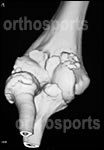
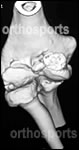
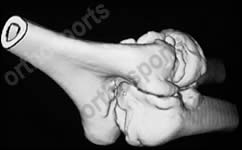
3 dimensional X-ray computerised images showing elbow arthritis
Rheumatoid arthritis is a disorder of connective tissue. The joint lining becomes irritated and the overgrowth of this tissue erodes cartilage, leading to destructive changes of the joint itself. The changes in the elbow joint limit mobility and often lead to deformity and pain. Usually other joints such as the hands and shoulders are also involved.
Surgery
Total elbow replacement is a very effective treatment in the correct patient. For most patients it is a last resort following medications, injections, splints and physiotherapy.
If you continue to have problems the surgeon may offer you an elbow joint replacement. The surgery creates access to the elbow and then the damaged part of the elbow is removed and replaced with artificial components called prostheses.
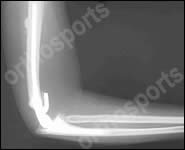
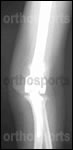
X-rays of an elbow replacement
As with all types of surgery you may not eat or drink from the time instructed by the doctor or hospital. You may take your cardiac medications with a sip of water on the morning of the surgery.
You may brush your teeth and rinse your mouth but do not swallow water.
Please remove all jewellery including rings from your hands and remove nail polish or artificial nails. After the surgery you will be taken back to your room where your arm will be splinted for a period of time. You will receive intravenous fluids and antibiotics for two days after the surgery and you will need to take antibiotic tablets for several days as well.
You may have a trapeze bar attached to the bed frame to help you move more easily. Do not pull or push with the arm that has the prosthesis in it. You may pull yourself up using the trapeze bar with your other arm. When in doubt call for assistance.
It is normal to experience pain or discomfort after surgery and ice may be applied to reduce the swelling and discomfort. Please inform the nurse if you are experiencing pain and they will provide you with pain medication.
During the first forty-eight hours after surgery you may get out of bed to use the bathroom but you must keep your arm elevated at all times.
When the surgical dressing is removed a lighter dressing will be applied and you will be encouraged to move your arm with the help of your other arm (a physiotherapist will supervise this initially). Your other arm provides it support as you begin to gain strength in the arm with the prosthesis.
You will then be taught to move your hand to your mouth as you learn to feed yourself. You will gradually require less help from the other arm and will practice this motion many times throughout the day in different positions (sitting, lying, standing).
The goal for you is to become as independent in your personal care and daily activities as possible before you return home. Your participation is vital in increasing your independence.
You may not drive for six weeks following the procedure.
Lifting
- For the rest of your life do not…
- Lift more than 4kgs at a time with the arm that has the prosthesis.
- Lift more than 2kgs repetitively with this arm.
- Push or pull forcefully with this arm.
Note
Lifting more than 4kgs or repetitive lifting or more than 2kgs with your arm that has the prosthesis can cause wear to the parts and damage the bones holding the prosthesis.