
{1}
##LOC[OK]##
{1}
##LOC[OK]##
##LOC[Cancel]##
{1}
##LOC[OK]##
##LOC[Cancel]##
HOME
CONTACT US
LINKS
SITE MAP
LOGIN
About Us
Doctors
Services we Offer
Preparing for Surgery
Appointments
Teaching
FAQs
Elbow Arthroscopy
Elbow Fractures
Elbow Instability
Olecranon Bursitis
Elbow Stiffness
Elbow Splinting
Tennis Elbow
Elbow Dislocation
Electromyographic Examination (EMG)
Osteoarthritis
Total Elbow Replacement
Ulnar Nerve Entrapment
Distal Biceps Rupture
Ankle Sprains and Ankle Ligament Instability
Athletic Injuries
Hallux Valgus (Bunions)
Heel Pain
Mechanical 2nd MTP Synovitis
Metatarsalgia
Neuroma
Posterior Tibial Tendon Dysfunction
Hip Arthritis
Hip Arthroscopy
Hip Resurfacing
Revision Hip Replacement
Total Hip Replacement Aftercare
Tronchanteric Bursitis
ACL Reconstruction
Knee Arthroscopy
Cartilage Transfer
Medial Collateral Ligament Injuries
Meniscal Repair
Meniscal Tears
Osgood Schlatters Disease
Osteotomy
Paediatric Knee
Patello-Femoral Pain
Popliteal Or Baker's Cysts
Revision Knee Replacement
Total Knee Replacement
Knee Pain After Total Knee Replacement
Uni Knee Replacement
Arthritis At The Base Of The Thumb
Bennett's Fracture
Boutonniere Deformity
Boxer's Fracture
Carpal Tunnel Syndrome
Colles Fracture
Complex Regional Pain Syndrome
Cortisone Injections
De Quervains Syndrome
Dupuytrens
FDP Tendon Avulsion - Jersey Finger
Ganglion Cysts
Hand Fractures
Hand Surgery
Mallet Finger
Mucous Cysts
P.I.P. Joint Injuries
Scaphoid Fractures
Scaphoid Surgery
Silicone Gel
Skiers Thumb
Trigger Fingers
Wrist Arthroscopy
Wrist Exercises
Arthroscopic Acromioplasty Video
Arthroscopic Rotator Cuff Repair Video
Labral / Bankart Repair Video
Slap Repair Video
Acromioclavicular Joint Degeneration
Acromioclavicular Joint Separation
Arthroscopic Acromioplasty
Arthroscopic Rotator Cuff Repair
Arthroscopic Shoulder Stabilisation
Biceps Tendonitis and Instability
Calcific Tendonitis
Clavicle Fractures
Cortisone Injections around the Shoulder
Frozen Shoulder
How to Apply a Sling
Neck and Shoulder Pain
Open Rotator Cuff Repair
Open Shoulder Stabilisation
Pectoralis Major Tears
Proximal Humeral Fractures
Reverse Shoulder Replacement
Rotator Cuff Tear
Shoulder Impingement
Shoulder Instability
Shoulder Rehabilitation
SLAP Tears
Swimmer’s/Surfer's Shoulder
Total Shoulder Replacement
Preparing for Shoulder Surgery
Cervical Spine Problems
Low Back Pain
ELBOW
Elbow Arthroscopy
Elbow Fractures
Elbow Instability
Olecranon Bursitis
Elbow Stiffness
Elbow Splinting
Tennis Elbow
Elbow Dislocation
Electromyographic Examination (EMG)
Osteoarthritis
Total Elbow Replacement
Ulnar Nerve Entrapment
Distal Biceps Rupture
FOOT
Ankle Sprains and Ankle Ligament Instability
Athletic Injuries
Hallux Valgus (Bunions)
Heel Pain
Mechanical 2nd MTP Synovitis
Metatarsalgia
Neuroma
Posterior Tibial Tendon Dysfunction
HIP
Hip Arthritis
Hip Arthroscopy
Hip Resurfacing
Revision Hip Replacement
Total Hip Replacement Aftercare
Tronchanteric Bursitis
KNEE
ACL Reconstruction
Knee Arthroscopy
Cartilage Transfer
Medial Collateral Ligament Injuries
Meniscal Repair
Meniscal Tears
Osgood Schlatters Disease
Osteotomy
Paediatric Knee
Patello-Femoral Pain
Popliteal Or Baker's Cysts
Revision Knee Replacement
Total Knee Replacement
Knee Pain After Total Knee Replacement
Uni Knee Replacement
HAND
Arthritis At The Base Of The Thumb
Bennett's Fracture
Boutonniere Deformity
Boxer's Fracture
Carpal Tunnel Syndrome
Colles Fracture
Complex Regional Pain Syndrome
Cortisone Injections
De Quervains Syndrome
Dupuytrens
FDP Tendon Avulsion - Jersey Finger
Ganglion Cysts
Hand Fractures
Hand Surgery
Mallet Finger
Mucous Cysts
P.I.P. Joint Injuries
Scaphoid Fractures
Scaphoid Surgery
Silicone Gel
Skiers Thumb
Trigger Fingers
Wrist Arthroscopy
Wrist Exercises
SHOULDER
Acromioclavicular Joint Degeneration
Acromioclavicular Joint Separation
Arthroscopic Acromioplasty
Arthroscopic Acromioplasty Video
Arthroscopic Rotator Cuff Repair
Arthroscopic Rotator Cuff Repair Video
Arthroscopic Shoulder Stabilisation
Labral / Bankart Repair Video
Slap Repair Video
Biceps Tendonitis and Instability
Calcific Tendonitis
Clavicle Fractures
Cortisone Injections around the Shoulder
Frozen Shoulder
How to Apply a Sling
Neck and Shoulder Pain
Open Rotator Cuff Repair
Open Shoulder Stabilisation
Pectoralis Major Tears
Proximal Humeral Fractures
Reverse Shoulder Replacement
Rotator Cuff Tear
Shoulder Impingement
Shoulder Instability
Shoulder Rehabilitation
SLAP Tears
Swimmer’s/Surfer's Shoulder
Total Shoulder Replacement
Preparing for Shoulder Surgery
SPINE
Cervical Spine Problems
Low Back Pain
Site Search:
Injection Techniques
Basal Thumb Arthritis Injection
Carpal Tunnel Injections
De Quervain's Injection
Hand Injections
Injections to the Acromio-Clavicular Joint
Intermetacarpal Blocks
Knee Injections Techniques and Indications
Subacromial Cortisone Injection
Trigger Finger Injections
Newsletter
Operative Animations
Operative Videos
Question for Physiotherapists
Orthopaedic Updates 2011
Orthopaedic Updates 2010
Orthopaedic Updates 2009
Orthopaedic Updates 2008
Orthopaedic Updates 2007
Orthopaedic Updates 2006
Orthopaedic Updates 2005
Presentation Index
Published Articles
Information Seminar Downloads
Useful Links
home
>
Teaching
>
Injection Techniques
>
Subacromial Cortisone Injection
Dr J Goldberg
Subacromial cortisone injections may be indicated for
Impingement
Rotator cuff tears
Calcific tendonitis
Diagnosis
Below I have described and illustrated my technique which has served me well over the last 20 years in Orthopaedic practice. It should be noted that these injections are simple to give and can provide gratifying results in patients who are in acute or chronic pain.
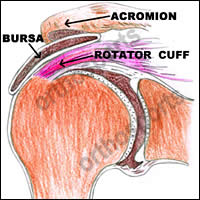
An understanding of anatomy is needed to ensure the injection is placed in the correct position. The aim is to inject the cortisone into the “bursal” area.
<>
back to top
I use a 10 ml syringe with a 23 gauge needle attached. I generally use 2 ampules of Celestone Chronodose combined with 8 mls of 1% Xylocaine. A lower dose of corticosteroid is recommended for diabetics and they must be warned to monitor their blood sugar levels for up to 72 hours.
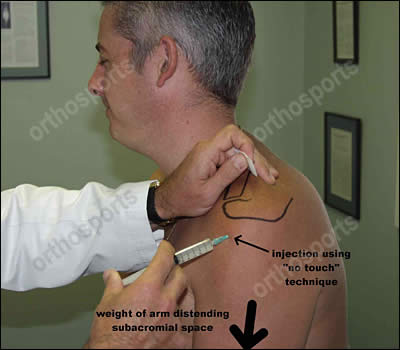
Infection can be a problem and a "no touch" technique can be used using an alcohol wipe or Betadine. If you do not have experience with a "no touch" technique then we recommend that you wear sterile gloves and use a prep tray.
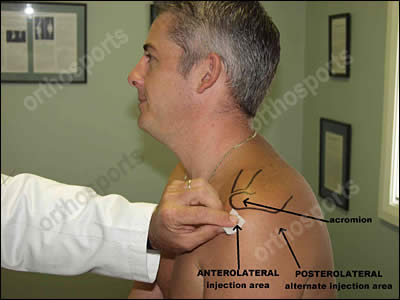
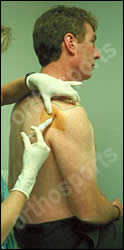
The aim of the injection is to place it under the acromion and above the rotator cuff, into the bursal area. This is a fairly large area and to make it easier to access, I have the patient sitting upright, so the weight of the arm opens the subacromial space even wider. I approach the subacromial space from an anterolateral direction. Many doctors find the posterolateral direction more to their liking and it is up to each doctor to use the approach with which they feel most comfortable. Once the needle is in position push the plunger of the syringe. The fluid should enter the subacromial space with ease. If there is any resistance stop, reposition the needle and inject again.
<>
back to top
Given correctly this injection is rarely painful but the patient may get some rebound pain after 2 hours when the local anaesthetic wears off.
With any procedure there are risks and complications. These include but are not limited to infection, allergic reactions and severe pain. All of these are exceedingly rare. It should be noted that diabetics may get a transient rise in their BSL.
<>
back to top
Copyright © 2009 Orthosports
Elbow Arthroscopy
-
Hip Arthritis
-
ACL Reconstruction
name:
Enter your email address:
CONCORD 02 9744 2666 | HURSTVILLE 02 9580 6066 | PENRITH 02 4721 1865 | RANDWICK 02 9399 5333
Copyright © 2009 Orthosports
HOME
|
CONTACT US
|
FELLOWSHIPS
|
LINKS
|
SITE MAP
|
LOGIN
|
RESOURCES
Netstarter -
Magento
,
Web Development
&
SEO Agency